
Extreme Weather: Building Greater Resilience into Our Community Game
Six months ago, many rugby clubs were looking anxiously at waterlogged pitches.
Three years ago, frozen ground caused widespread disruption to fixtures.
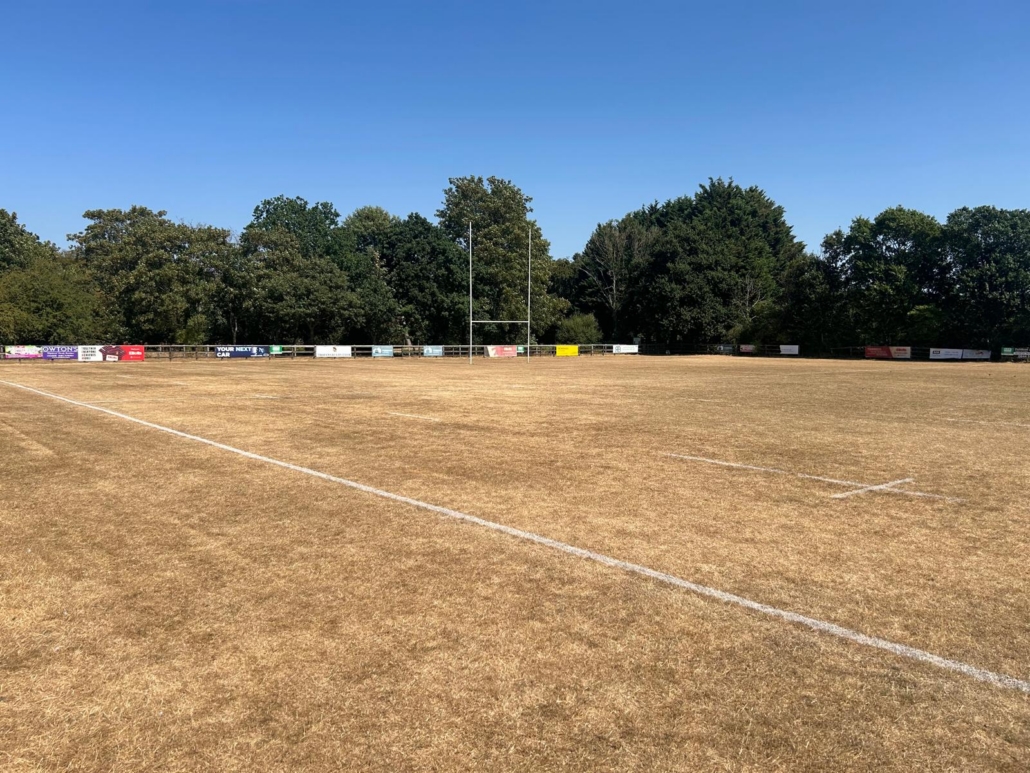
And now, unusually dry conditions have left pitches exceptionally hard and raised a different set of concerns around player welfare.
None of these challenges are new. Weather has always affected community rugby. What is becoming increasingly important, however, is our ability to respond to greater variability in playing conditions and to think more strategically about how we keep rugby on.
For Hampshire RFU, with over 11,500 registered players across the adult and age grade game, that matters.
Because every game lost has an impact.
More than a postponed fixture
The immediate consideration must always be player safety. If a pitch isn’t safe, rugby shouldn’t be played on it.
But when games are lost, the consequences extend beyond the fixture itself.
Players lose an opportunity to play. Coaches and volunteers lose the activity they have spent time preparing for. Competition programmes become more difficult to manage and, particularly in age grade rugby, another opportunity to keep players engaged in the game disappears.
There is also a direct financial consequence.
A home fixture brings players, supporters and visitors into a rugby club. They use the bar, buy food and contribute to the wider matchday economy. When that fixture disappears, much of that income can disappear with it.
One postponed Saturday or Sunday may have a relatively small impact. Several lost weekends across a season can be much more significant.
That is why rugby resilience and financial resilience are increasingly connected.
Hampshire RFU has already been working with clubs on revenue generation and encouraging them to think beyond traditional reliance on membership subscriptions and bar sales. Greater diversification of income helps clubs absorb disruption when circumstances outside their control mean rugby cannot take place.
But an equally important part of the answer is doing everything reasonably possible to prevent games being lost in the first place.
Finding ways to play
There will always be occasions when postponement is unavoidable. The challenge is ensuring it is the last sensible option rather than automatically the first.
Competition guidance and regulations provide mechanisms for managing disruption, including reserve weekends within the calendar. Those are important safeguards and provide somewhere for fixtures to go when they genuinely cannot be played.
But before reaching that point, there are often practical alternatives worth exploring.
- Could the fixture be reversed and played at the opposition ground?
- Could a neighbouring club provide a suitable pitch?
- Is a neutral venue available?
- Could an all-weather pitch be accessed?
- Could greater flexibility around kick-off times allow more than one fixture to use a playable surface across a weekend?
- Could Friday-night rugby under lights provide another opportunity?
Not every solution will work for every club or every fixture. Nor should finding an alternative ever override an appropriate decision about player welfare.
The principle, however, is simple: communicate early, work collaboratively and explore the sensible options available to keep the game on.
Hampshire is fortunate to have a strong network of clubs and volunteers, and greater collaboration between them could become an increasingly important part of how we manage future disruption.
We need more resilient places to play
There is also a longer-term question.
If we experience periods where pitches are too wet, too hard or frozen within the same playing season, our facilities need to become more capable of responding to those extremes.
For some clubs that may mean better drainage or improved pitch maintenance.
For others it could mean floodlights, creating greater flexibility around when rugby can be played.
Across the game, access to all-weather pitches will also become increasingly valuable, particularly where facilities can support several clubs, schools and community programmes within a geographical area.
These are significant investments and they will not happen everywhere or overnight.
But that makes planning for them more important, not less.
Becoming investment-ready
One of the messages Hampshire RFU will continue to promote is the importance of clubs being investment-ready.
Funding opportunities inevitably emerge – through the RFU, local authorities, partners and other organisations – but clubs are in a much stronger position to take advantage when they already understand what their facilities need.
That means having a facilities plan.
It means understanding the condition and capacity of pitches.
It means considering what improvements would make the biggest difference to the amount of rugby that can be played.
And, importantly, it means developing sufficient financial resilience to contribute towards investment when opportunities arise.
The ambition does not need to be an all-weather pitch at every rugby club. A relatively modest investment in drainage, irrigation, maintenance equipment or floodlighting might provide a much greater return for an individual club.
The starting point is understanding the problem we are trying to solve: how do we create more opportunities for rugby to be played?
Protecting the game – and the club behind it
This is where facilities, competitions and revenue generation increasingly come together.
A more resilient pitch means more games can be played.
More games mean more opportunities for players to participate and remain connected to rugby.
They also mean more people coming through the clubhouse and greater opportunity for clubs to generate the income that ultimately supports their rugby programmes.
At the same time, clubs with broader and more sustainable sources of revenue are better able to withstand the occasions when fixtures inevitably are lost – and are more capable of investing in the facilities that reduce future disruption.
It becomes a virtuous circle: better facilities support more rugby; more rugby supports stronger clubs; and stronger clubs are better placed to invest in their future.
Planning for what we can control
Community rugby will never remove weather from the equation.
Six months ago, the concern was waterlogged pitches.
Three years ago, it was frozen ground.
At other times, like now, it will be drought and hard surfaces.
We cannot control which of those challenges arrives next.
What we can control is how prepared we are for it.
That means sensible competition structures with contingency built in. It means reserve weekends when they are needed. It means clubs communicating and collaborating rather than operating in isolation. It means thinking differently about when and where games can be played.
And, increasingly, it means investing in the resilience of both our facilities and our clubs.
The objective is ultimately a very simple one: